A working person in Vologda has no more place to grab a pint. On 1 March 2025, Governor Georgy Filimonov restricted the sale of alcohol on business days to the lunch hours of noon to 2pm. Then, one year later, Vologda’s war on drunkenness entered a new phase when it came for the so-called nalivayki — “watering holes”, or unlicensed pubs that sell cheap groceries alongside alcohol. They were ordered to close by 1 May. But there was no ban on buying the stuff. To see how this experiment is unfolding, Novaya Gazeta Europe went for a drink in Vologda.
‘An apartment building is just not the right place for it’
No proper Russian citizen likes nalivayki. Named for the Russian verb ‘to pour,’ these shops sit on the first floors of apartment buildings and operate as unlicensed pubs, selling poured alcohol alongside cheap staples like pasta, sausages, buckwheat and ice cream. People like the availability of discount groceries around every corner, but not so much the alcohol-buying customers. Yet it’s precisely these customers who keep the pasta prices down.
“See this playground of ours?” a woman says, pointing to the courtyard of Building 94 on Hertzen Street. “On that side of the building there was a store. It sold open bottles, but what was even the point? People just brought their drinks right to the playground. The residents here fought for a long time to shut this place down.”
Ninety-four Hertzen Street is well known locally for being one of the most successful wins in this war. One day in April, the building’s nalivayka stopped opening its doors, and an announcement said it had closed forever. Credit was due to a resident named Yevgeniya (name changed). Not long after the pub opened last September, she filed a complaint on the city administration’s website, which eventually led to the venue’s closure. Yevgeniya had personally not been too bothered by it: her family didn’t have children. Her real concern was public order.
“The drunks kept out of our way, staying on the playground,” she explains. “The pub warned them to keep it down and not make a mess under our windows. It was more about the inconvenience of having this venue right below us — an apartment building is just not the right place for it.”
A few days after the nalivayka closed, an announcement popped up on its door with a new address. On the same street, just a few blocks away, was not just a new grocery-pub, but a full-service bar called “Hoppy Barrel”.
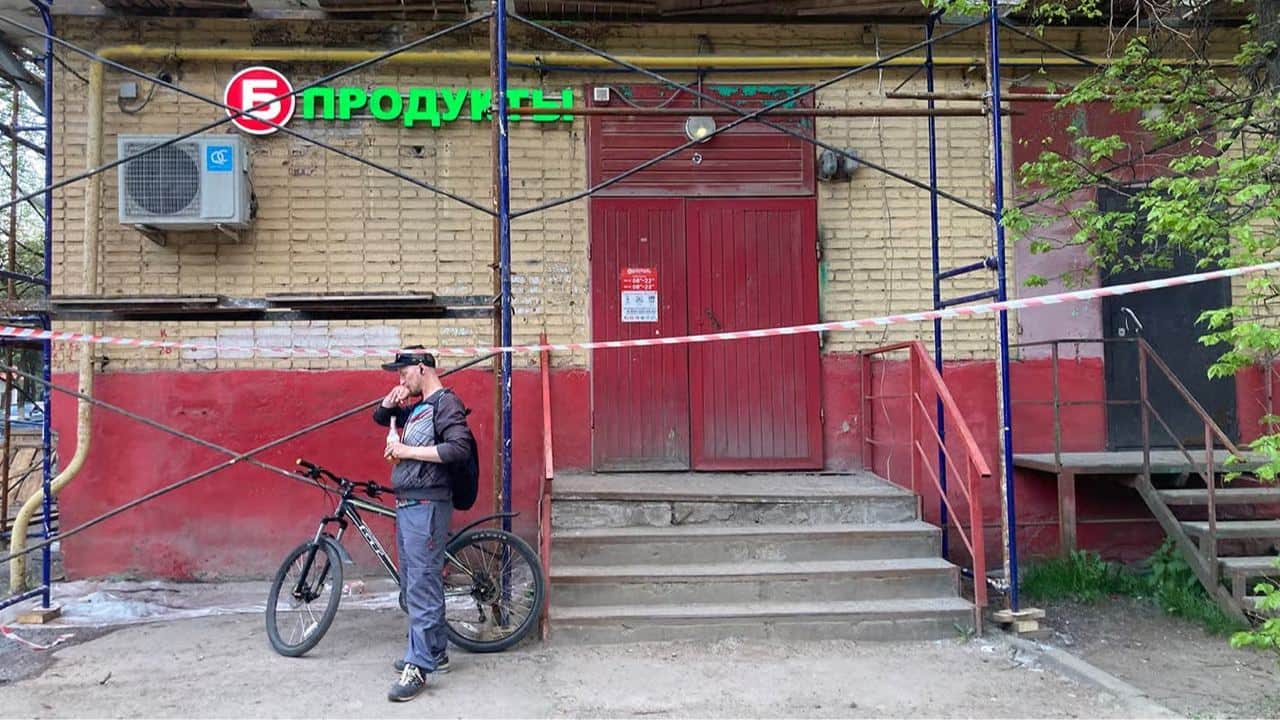
KB Products store. The unmarked door on the right is an operating alcohol takeaway point. Photo: Irina Garina / Novaya Gazeta Europe
‘I can show you a million of them right now’
Ilya (name changed), a manager at a wholesaler supplying alcohol, explained the simple workaround. “The new law permits only restaurants to serve alcohol around the clock. Nearly everyone is trying to survive by rebranding themselves, so they add a few tables and voila — it’s a restaurant.”
Two days before the 1 May deadline for all of Vologda’s nalivayki to close, Governor Filimonov announced that they were shut down — all 125 of them, by his count.
“I can show you a million of them right now, if you want,” laughs Misha, a taxi driver.
He stops the car on Lermontov Street. The first floor of Building 15 is boarded off with plywood. A sign reading ‘Bar’ hangs crooked above the door. It is open 24/7. Behind it, a descending staircase spirals into total darkness. There are no customers in the basement, and a middle-aged blonde server is killing time. It’s too dark to make out the bottles behind her.
“Come back in the evening — that’s when the crowd shows up,” she suggests.
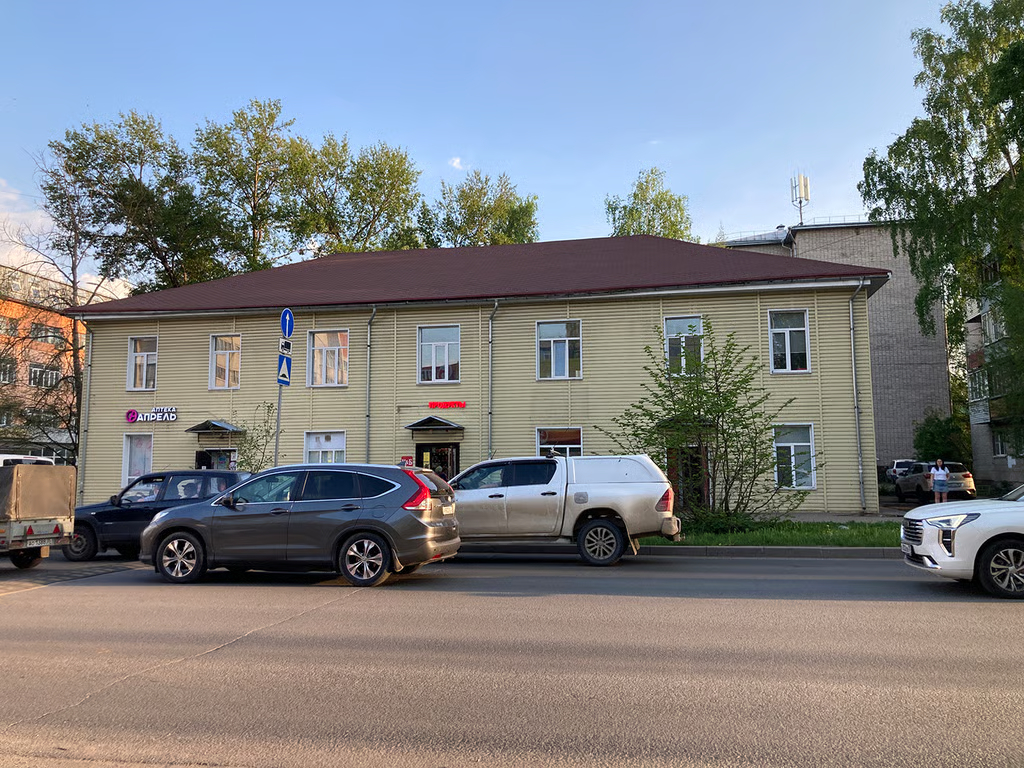
The two-story apartment building on Karl Marx Street, meanwhile, bears no “bar” sign. There’s just a red door, invitingly open, next to a grocery store with a pharmacy. Inside is a room with two small tables and a wall with the names of the beers on tap written in chalk. You can bring your own container, and the server will pour it.
“I’ve never run into bootleg stuff there,” Misha says. “But they pour it from a keg, and who knows what’s inside. I buy cider from a nalivayka on Sovetsky. It’s very tasty, like lemonade.”
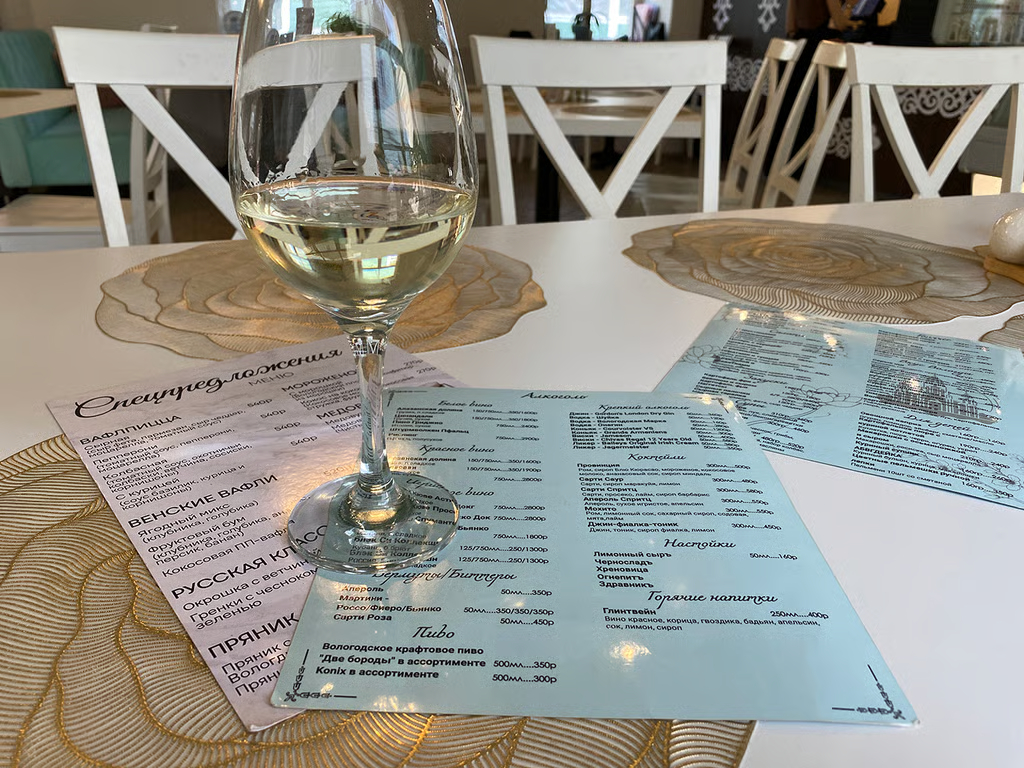
A café opposite the Vologda Kremlin. Photo: Irina Garina / Novaya Gazeta Europe
Governor Filimonov recently erected a statue of Ivan the Terrible on Vologda’s main square, right next to the city’s Kremlin. The Grand Prince is flanked by red shields bearing the words that this is the “centre of the Russian world”. The governor likes this theme, and the city is crammed full of bronze statues. The most prominent one is of Joseph Stalin. A Vologda court has ordered it removed due to its improper funding, yet it still stands.
“They put up these things all over town,” says Vologda resident Igor. “They’re all made of bronze that was taken from the fence in the city centre… They melted it down into all these sculptures.”
In front of Ivan the Terrible, the Province Café offers ice cream, local cuisine, cabbage soup, and waffles. A bottle of white wine goes for 1,600 rubles (about €19). Riesling is 2,900 (around €34). Spirits are priced in units of 50 grams but customers can buy them by the bottle. The girl who poured me 150 grams of the white for 350 rubles (€4) warned me that the bottle would be open. But that said, she added, I could buy whatever I liked.
“We have nalivayki in the neighborhood,” an older guy with a cigarette and a bottle of beer told me on Chernyshevsky Street. “Everyone knows where they are — one is always a stone’s throw away. Except, the price there might be at a 2X or 3X markup. But bars also sell with no problems. Take a seat, have a drink, and grab the rest of it to go.”
The shop where we struck up the chat had a simple name: B-Groceries. Coming a bit closer, you could see the old sign on the door: Bristol — one of Russia’s biggest alcohol chains until recently.
Like in the rest of the region, no alcohol chains like Bristol, Red and White, and Degree (Gradus) are left in business. To be more precise, there are no more shops bearing these names.
Lera, who is visiting from Cherepovets on business, explains this workaround.
“The law puts it in such a way that doesn’t necessarily force them to close; it’s enough to just change the name. There just can’t be anything alcohol-related in it. So Bristol is now B-Groceries.”
“Even so, there are a lot fewer of them now,” admits Ilya from the wholesaler. “Of course they were forced to change their names, as these are national chains. But they’re in business all the same. The same is true for Magnit and Pyatyorochka supermarkets: alcohol is 40 per cent of their profits. There is no difference on the shelves.”
On Monday evening I walked into a nameless shop on Shchetinin Street. There was no cordon at the liquor corner like in typical Russian stores. I randomly picked a bottle with berries on the label and some tangerines. The cashier scanned the tangerines but nervously eyed the bottle.
“This is no-go,” she said. I thought that this meant alcohol in general. Later, though, Ilya explained that this was a particular bottle that the shop was not ready to sell. To buy booze, I should have asked the cashier which other specimens of this were allowed, and she would offer two or three options.
“In grocery stores, alcohol can be scanned during the ‘allowed’ hours [from 12pm to 2pm],” Ilya said. “However many they scan, that’s how many will be bought. If the customer didn’t buy what they wanted in time, they’ll take whatever is available.” The ladies at Bristol simply pre-scan the alcohol to make it appear as if the purchase occurred within the allowed window, according to the wholesale manager.
Ilya adds that Vologda’s drinking has not gone down. If anything, it’s gone up, as the vendors’ new working hours have changed consumer behavior.
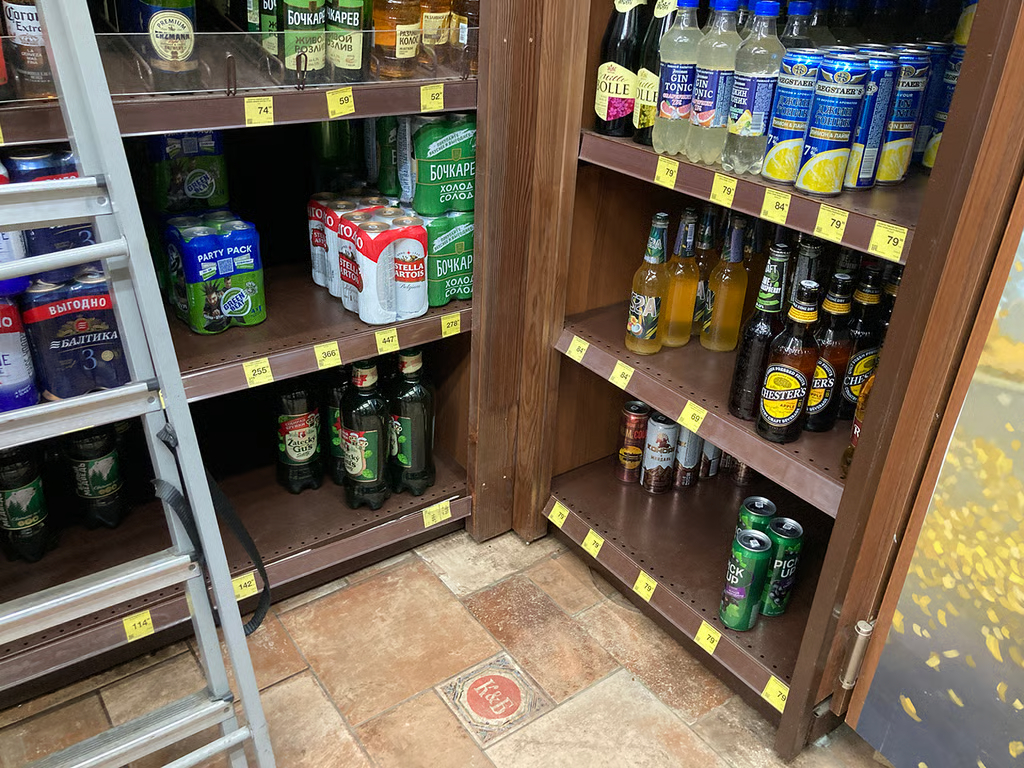
Shelves in the wine section of B-Groceries. Photo: Irina Garina / Novaya Gazeta Europe
“A person might once have bought, let’s say, five bottles for the evening,” he adds. “If he wanted more, he would buy two more bottles. That’s all. Now he buys a whole case at lunchtime. And it’s just human nature: he will drink exactly how much he has on hand. During lunch tomorrow, he’ll buy another case.”
Four stars
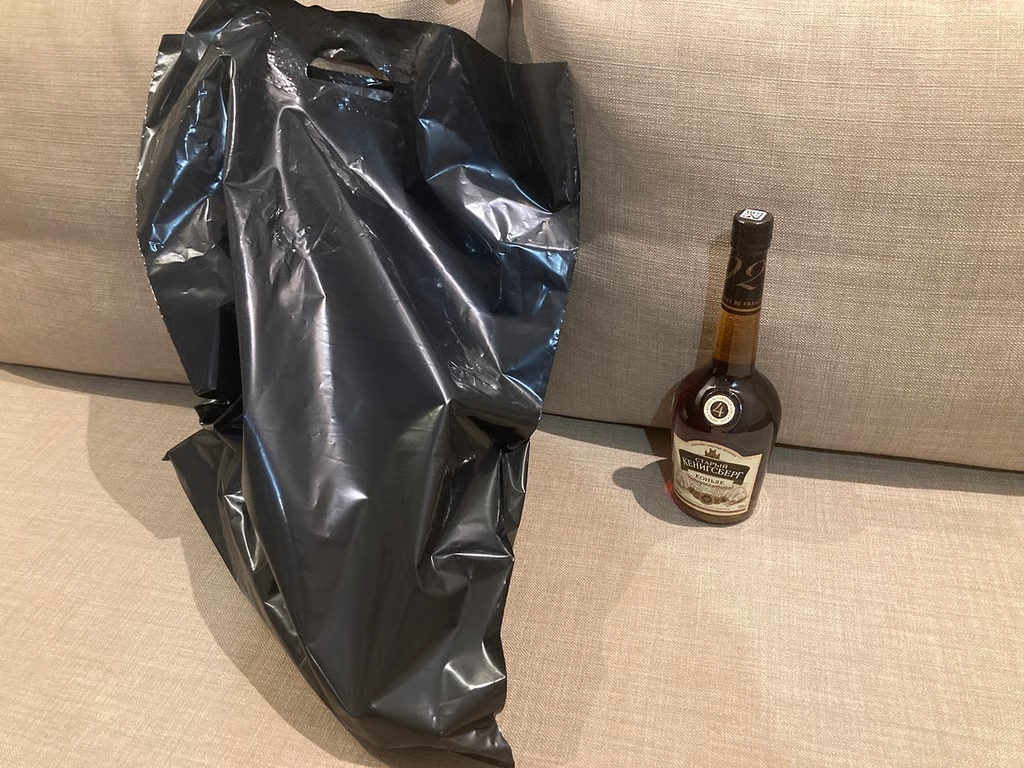
It’s 10pm on Monday. A dim lamp lights a narrow street in the quiet centre of Vologda. A black Renault Duster is supposed to arrive for me in three minutes. Right on schedule, the headlights appear around the corner. A female driver stops under the streetlamp, steps out, and hands me a big black plastic bag.
I take it without checking its contents. Without counting my bills, she gives me the exact change. I will not open the bag until I’m back in my hotel room. It will contain precisely what I bought with 1,500 rubles (around €18): a bottle of four-star Konigsberg cognac. It costs 700 rubles in the nearest Pyatyorochka supermarket — but for that I’d have to wait for tomorrow, between 12 and 2pm.
Half an hour earlier, I dialed a secret phone number that I retrieved from one of Vologda’s many taxi drivers. Even in the Soviet Union, pubs were not open at night, so often the only option was to buy a drink from a taxi driver at a marked-up price.
The first taxi driver I asked shook his head and scrutinized me in the rearview mirror. He even rolled the windows down to interfere with hidden microphones.
“And what would you like?” he asked with suspicion.
“Cognac,” I replied.
“Why didn’t you buy it at lunchtime?”
It was around 2:45 PM; an hour ago, I could have bought anything I wanted at the supermarket. “This could be a sting,” he explains. “I could be pinned with some sort of illegal commerce.”
Then he calms down: “I only carry the cheap stuff, what I can drink on my own. I have ordinary vodka. How much do you want?”
He was ready to sell a half-litre Khlebnaya — about 400 rubles (under €5) in a regular grocery store — for 1,000 rubles (around €12).
The second driver I asked was fearless and spoke freely.
“I usually just drive on the weekends, so no one even asks,” he confessed. “But there is a guy who moves beer, spirits, even fruits, and cigarettes. He has bottles and candy in his trunk. You open it and it’s a full bar.”
In the summer, he says, these goods sit in the trunk all day. In the winter, alcohol freezes, so he carries the bag home for the day. Neighbors give him a strange look as he shuttles crates or plastic bags back and forth. I suspect he stocks up on the weekends, buying what is on sale at Bristol. He does not pour anything — only unopened bottles, none of the fake stuff.
After finishing that sales pitch, he gave me the phone number. The password is his car model and license plate.
“Ask for Vova,” he continued. “He’ll ask who you’re from. You need to say ‘Rio-250’. I also get a cut from that. A thank-you, so to speak.”
Vova’s phone is busy for a while. Later, he answers on the first ring.
“I got your number from Rio-250,” I start.
“Understood,” Vova says. “What would you like?”
“And what do you have?”
“A bit of everything. Vodka, cognac, whisky, gin, rum, tequila. How about some nice little cognac? I have Stolichny, Konigsberg — four stars, 1500 rubles (under €18). Yup, Konigsberg is four stars. Where are you located? The car will come in 20 minutes, I’ll call you.”
In exactly 20 minutes Vova called me back. The black Renault Duster approaches. That’s how I bought a four-star cognac at double the price. That said, I rated the service five stars.
Cognac from the taxi driver. Photo: Irina Garina / Novaya Gazeta Europe